That (@*#^ Edit Cycle by Janine M. Donoho

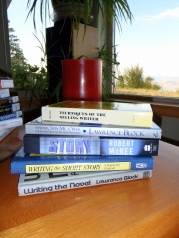
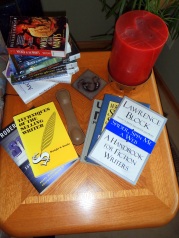
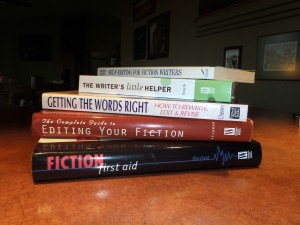
A few editing books that help

A few editing books that help

Let’s start with a confession–of sorts. My greatest joy in writing comes with the hot, fast gallop of first drafts. By then the story’s bones and sinews have developed enough so that each session equates with a joyous fleshing out of details. During this phase I can’t wait to leap from bed each morning–and hit the pillow enthralled by story each night.

Then looms the dragging, nagging edit. Some otherworldly creatures find this stage fun; I find it excruciating.

This is different than the macro-edit housekeeping accomplished while writing draft. Reviews of previous day’s work cover structure, plot, tone, pace, etc. I almost wrote ‘theme’, but that’s not always clear in the early stages. Along the way, I deepen conflict and sharpen reversals.

Worse yet, my après draft edits rarely clear the high jumps, much less the double ‘oxers‘, although I do fine over ditches and logs. What’s missing? Well, the heart pounding excitement’s gone, baby, gone. Only a plodding satisfaction remains. Which should be enough, right?

Self talk: “This isn’t my first rodeo. I’m disciplined and well-read. Both sides of my brain receive high quality nourishment and play well together. I can do this.”

Beyond the analysis of editing books, then applying what I learn, I’ve tried other ballyhooed remedies to make this work. The manuscript, hereinafter known as ‘mss’, rests like a freshly broasted chicken while I work on other projects. I do yoga–breathe–meditate–breathe–take long hikes–breathe. Then I go through the mss and ruthlessly scribble editing and proofreading marks learned in the aforementioned tomes. At that point I return to my computer and make these changes.

Then it’s time to surrender fully to the left brain for reviewing content, consistency in style, clarity and flow. I crawl ant-like over scenes for grammar, word usage and accuracy. Finally I read it aloud–or try. After a few pages, I realize I’ve gone silent again–and again–and again.

Cactus prickly pearBy this time I find nothing to like about my story and would rather walk barefoot in a prickly pear patch than read through it once more. My aversion signals the next stage. The mss goes to one or two first readers–published authors with whom I trade this boon.

They always find misspellings and points of unintended confusion. Yes, actual gnashing of teeth and clenched jaws transpire. How did I miss these obvious errors?

So I put on my big girl panties and fix them. The story’s deemed the best that it can be. It’s released into the world.

Then I swear, a few days, weeks or months later? A misspelling here, verb confusion there, dropped words, a formatting error that slipped beneath the motion-activated fence. Dissatisfaction plagues me. For what good is editing if it fails to make your story the best that it can be?

So next time I complete a new project, I’m considering a professional editor–one worthy of manna, dark chocolate, and ambrosia drenched in morning dew from hummingbird wings. Oh, and one who won’t break my fragile piggy-bank.Editing

Build the Foundation & Story Will Come by Janine M. Donoho

OLYMPUS DIGITAL CAMERASince joining online communities, then enjoying the first steps of writers new to their craft, I delight in their growth. The freshness of their vision and their infatuation with words reveal elements leading to stories I want to read.

I suspect that’s how many of us writers begin. Then if we want to publish, we dig deeper and learn more about craft. One of my early ‘ah-ha’ moments occurred thanks to seasoned critique partners and great library systems.

With that in mind, let me share a simple technique for building story foundations. Since many grandmasters have gone out-of-print and indeed, gone elsewhere, here’s what I distilled from their works. Prepare to be dazzled:

Goal, Obstacle, Resolution.

Okay, dazzled may be too strong a word. Yet on longer projects, applying this method calmed my pre-project jitters so I could begin. Often I view story as scenes leading to chapters leading to a completed novel or even as scenes leading to acts with a progression of rising and falling actions. Here’s how I apply necessary groundwork:

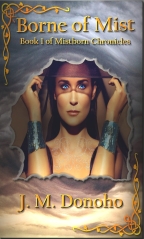
MB Bk 1 Kindle Cover w. Ctr. LtgTake the first chapter from Book 1 of MISTBORN CHRONICLES*, Borne of Mist:

Goal: Introduce the world’s increasing strangeness via Zenadon MelʹChaime, who must accept the challenge to save his world.

Obstacle: Zen doesn’t want to believe that what’s happening has anything to do with him–he’s happy and comfortable as Master Merchant.

Resolution: He chooses to meet with the Mist-Spawn.

I know, I know. It’s clunky. That’s not the point. After beginning, then finishing a dozen novels, this process alleviates my boggles. Boggles, you ask? Well, the trepidation that there’s not enough story to grow a novel, a series–or even a short story, for that matter.

You can also use this technique for developing character arc. Here’s an example for Elishandra ser Danche′ sere Jillian:

Goal: Her survival depends upon placing Morchem on the defensive, then neutralizing him.

Obstacle: He’s stronger than she and obsessed with her; their last conflict ended with her teacher dead and Lisha crippled.

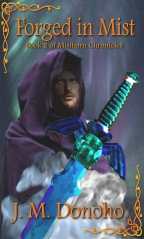
Resolution: Motivated by her commitment to this world and others, she discovers the strength to rebuild her magic within the confines of the world’s natural systems.Forged Cvr. 4

Don’t judge me. I lifted these directly from my early visions of MISTBORN*, circa 1998. With the series complete, it’s surprising how much of the original structure endured–a matter of modifying framework versus carving stone.

Here are a few keepers from my private shelves: Techniques of the Selling Writer by Dwight V. Swain, Writing the Novel from Plot to Print and Spider, Spin Me a Web by Lawrence Block, Story – Substance, Structure, Style, and the Principles of Screenwriting by Robert McKee, Writing the Short Story by Jack M. Bickham. Yes, yes, lots of boys in this club–but also master storytellers. You can take what you choose from them and crystallize your process.

Let me know if this helps or hinders you in your quest for story. I wish you joy in your writing.

*Caveat: I originally called my series MISTBORN TRILOGY, which my then-agent sent to TOR, who had another series in the pipeline and passed on mine. Lo and behold–Brandon Sanderson’s MISTBORN TRILOGY, which except for the series title is nothing like mine. So there.

OLYMPUS DIGITAL CAMERA

Adjust Your Mind & Own Your Title: Author by Janine M. Donoho

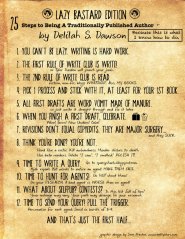
Lazy Bastard Edition of Publishing Pt 1Read this great blog ‘25 Steps to becoming a Self-Published Author’ from Chuck Wendig via Delilah S. Dawson and her mighty unicorn. It covers ‘self’-publishing, adjusting your mind to rock the process, and how we own our ‘Author’ title. Here’s the link and I wish you belly laughs, insightful chuckles and renewed joy in your writing adventures.

Lazy Bastard Edition of Publishing Pt 2

Worlds within Worlds by Janine M. Donoho

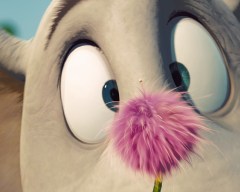
Horton Hears a WhoDon’t you simply love Dr. Seuss’s HORTON HEARS A WHO? For me the story served as a watershed event as I grappled with string theory and quantum mechanics. HORTON also informs my approach to storytelling.

We writers yearn to create places that we’ll miss when we’re away. To finish our stories, our worlds need to cause a relentless itch that brings us back each and every day. Once we finish our stories, we intend that our readers find our world-building irresistible, too.

To engage our audience, certain features prove vital. Primarily our readers need to suspend their disbelief. That means seamlessly arranging entire worlds of physical systems, societal taboos and mores throughout a complex landscape. Let’s make this our starting point.

My foundation in MISTBORN CHRONICLES? A bucolic world lacking in magic and advanced science. When the curtain MB Bk 1 Kindle Coverbetween worlds rips open, wild magic invades like a viral attack. Ah, you recognize ‘the call to adventure’? Rather than revisit what others like Joseph Campbell and Vogler explain so well, let me focus on the aspect that proves most interesting to me—the ‘what if’ game.

So my friends, time to put on your critical-thinking-hats. Begin with the magical influx…

What if certain species and individuals prove genetically sensitive to transformation? What if some cannot mentally or biologically handle the change? What if the one person who understands the linkage between science and magic has lost her abilities and is trapped in this world? What if her skills make her suspect? What if she cannot diagnose the harm done to her without cueing a rapacious predator to her location? What if a master merchant, who sees himself as average and anything but heroic, finds himself a repository of the extraordinary?

You see how this process works? This drama continued for over 1500 manuscript pages. Yes, a series was born. The trick? How to apply this ‘what if’ practice to each level of conception, including species’ physiology and cultures along with suites of universes bumping up against each other.

We writers set the rules, then play within those parameters. Otherwise our readers cannot suspend their disbelief. If we fail, they’ll toss our stories across the room in exasperation. As an abused reader, I learned this response firsthand.

Many books take us into their worlds, shape us, then ensnare us as return visitors. For me, Tolkien’s LORD OF THE RINGS, Guy Gavriel Kay’s FIONAVAR TAPESTRY, Orson Scott Card’s ENDER’S GAME, Anne McCaffrey’s DRAGONRIDERS OF PERN, Patricia McKillip’s RIDDLEMASTER OF HED and George R. R. Martin’s A SONG OF ICE AND FIRE (1st three novels) exemplify mastery. First came my appreciation for these stories along with a willingness to immerse myself in them. Later I returned to read them more analytically. Even now, I lose myself in their preeminence.

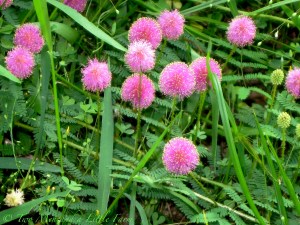
So what’s your key approach to world-building? How do suspend your reader’s disbelief?Horton's Who Flowers

Since I’m visually driven by seasonal changes and travel with eyes wide open, you’re invited into glimpses of my textured and colorful writer’s journey. Simply click on each link and enjoy. Virtual conversation is always welcome.


What I love to create


My Writer’s World = Readers Welcome


Who I am at heart

Link

A Quality of Light by Janine M. Donoho

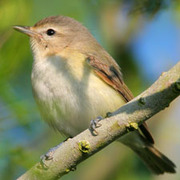
Warbling VireoDo color and texture equate with sound for you? Consider the warbling vireo

Panting whippetIf we allow ourselves to do so, we humans revel in sensory input. Then there’re those extreme moments when our survival depends upon paying attention to our environment. As writer and fledgling artist, I try to capture sensory qualities. This presents an ongoing challenge.

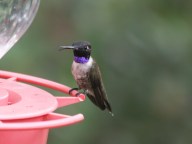
For whatever reason, today’s hike focused on visuals accompanied by sound. Have you allowed yourself to become Sunlight through leavesfully engaged within properties of illumination? At different times sunlight through leaves captivate as a zephyr Black-chinned Hummingbird, adult malerustles an aspen branch. Or the sheen off my whippet’s brindle spots and my greyhound’s tortoiseshell coloration enchant me even as their panting ripples light along their coats. Then there’s the bending of light that gives feathers their iridescence as a black-chinned hummingbird shrilly claims his territory. Texture combines with color and sound to draw me. When that happens, my breath catches and the pace falters.

During my final edit of CHOSEN BY MIST, book 3 of the MISTBORN CHRONICLES, I attempt to infuse detail into story without losing pace or scene focus. Sometimes it works. How do you incorporate sensory detail into your writing and visual art?Mariposa lily with lupine

Feeding Hope by Janine M. Donoho

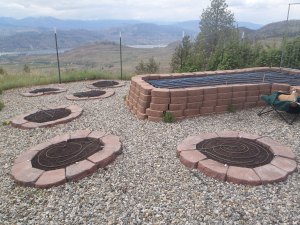
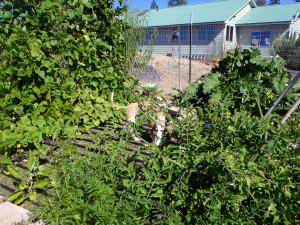
Planting the moundsEach spring I plant my annual fruit and vegetable gardens. While winter offers the joy of seed catalogs and visions of succulent melons, eggplant and tomatoes dance through my mind’s eye, the real application starts once frost’s threat ends. During the planning stage, I dream big–think Mediterranean shoreline big.

Then I get a grip and narrow my choices to the reality of intense gardening-by-the-square-foot. At this stage companion plants come into play. That denotes matching cucumber with pole beans and radishes, which belly up to peas and carrots before leading into tomatoes, basil and…

Poster for Companion PltgWell, you get the idea. Separate mounds hold my hopes for watermelon, honeydew and cantaloupe, and brassicas. Since I love kale, beets and mescuns, you’ll find those, too. I mix basils, nasturtiums, and marigolds among plantings that benefit from their association. You’ll find spinach amid my strawberries, too.

So what do I relearn each growing season? Why how much groundwork, planting and harvesting a garden has in common with writing. It becomes a litany:

Plan

Amend

Plant

Revise

Harvest.

Yes, a garden benefits from editing much as stories do. In the final stages I force myself to be ruthless in both while taking the useful and transplanting it elsewhere for superior impact. It’s how I approach my current edit of MISTBORN CHRONICLES, book 3.

As often happens my process makes me curious about yours. How do your life practices move your writing from here to there? Is your life shaped more by how you approach writing? Or does writing mold your life choices?

IG in the greens

Guest Post with a Reiki Master by Janine M. Donoho

Gorgeous caveA few months ago Reiki Master and sublime writer Imogen Knight, author of The Reiki Circle, and I connected via an author site. She invited me into her world for a guest blog and I thought, ‘This could be fun’. Today my blog The Writer’s Cave goes live. You’re invited to visit Imogen’s site, read my blog and take a virtual walkabout at her site. Let us know what you think.

Sending love deviant artists

Sending love to deviant artists

Kate’s Garden by Janine M. Donoho

Madrone CommunityAlong my way to an oceanfront writers’ retreat, this parched desert woman received the gift of Kate’s garden. Fitted like a jewel in the bezel of coastal Washington, her garden’s the opposite of dry. I sipped coffee surrounded by lush morning filled with intricate songs from MacGillivray’s and Wilson’s warblers, Swainson’s thrush, and the ubiquitous Robin. Cacophonous geese winged northeast–perhaps toward my high desert.

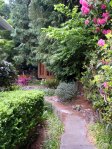
Serene PathKate’s artfulness shows in her placement of azalea, stone, rose and bench. Prayerful seating maximizes natural connections. Her latest Mother’s Day hydrangea–deepest pink–confirms how much she’s loved. Even the air smelled green with plant exhalations and floral abundance.

Her stunning historical FOR SUCH A TIME from Bethany House Publishers launches April 1, 2014. Even though her novel’s been endorsed by heavy-hitter Debbie Macomber, Kate’s too shy to tout her own bona fides. Besides that’s what fan-friends are for…

Like many of us creatives, she balks at misrepresenting herself.Serenity What that equates with? We fail to reach out to the very readers who want and need our work. Since she writes inspirational fiction steeped in history, I’ve no doubt that her readers will come. To help that happen, watch for updates both here and at http://katebreslin.com/.

Mature garden spaceI hope you enjoyed this pictorial journey. Right now Kate’s wrestling with how to make her next novel as life-enhancing as FOR SUCH A TIME. Meanwhile I’m infatuated with editing my next MISTBORN CHRONICLE.

So I shared–now it’s your turn. What’s riveting your attention and getting you out of bed each morning?OLYMPUS DIGITAL CAMERA

True North by Janine M. Donoho

Anna's Hummingbird

The science of true north

Bundles in magnetic snouts

Of rainbow trout or the 

Cryptochrome eyes of Anna’s Hummingbirds.

Even cows align along axes north-to-south.

Lacking their animal magnetism

I face into polar winds

Cascading from icy fields

Where Auroras shimmer.

My shivering hounds race toward me–

A locus of heat and comfort.

Aurora Borealis

Previous Older Entries Next Newer Entries

Soundings, Water Elemental

LaunchFebruary 27, 2015
The big day is here.

Newsletter signup

Join in and receive a FREE short story as my gift to you. Exclusive promos, book deals and contests available only to subscribers.